Showing posts sorted by relevance for query mugs. Sort by date Show all posts

Friday, November 4, 2011

MUGS--THE LIST

Verbal list of mug images
See Mugs, Mug Shots for pictures of the various styles

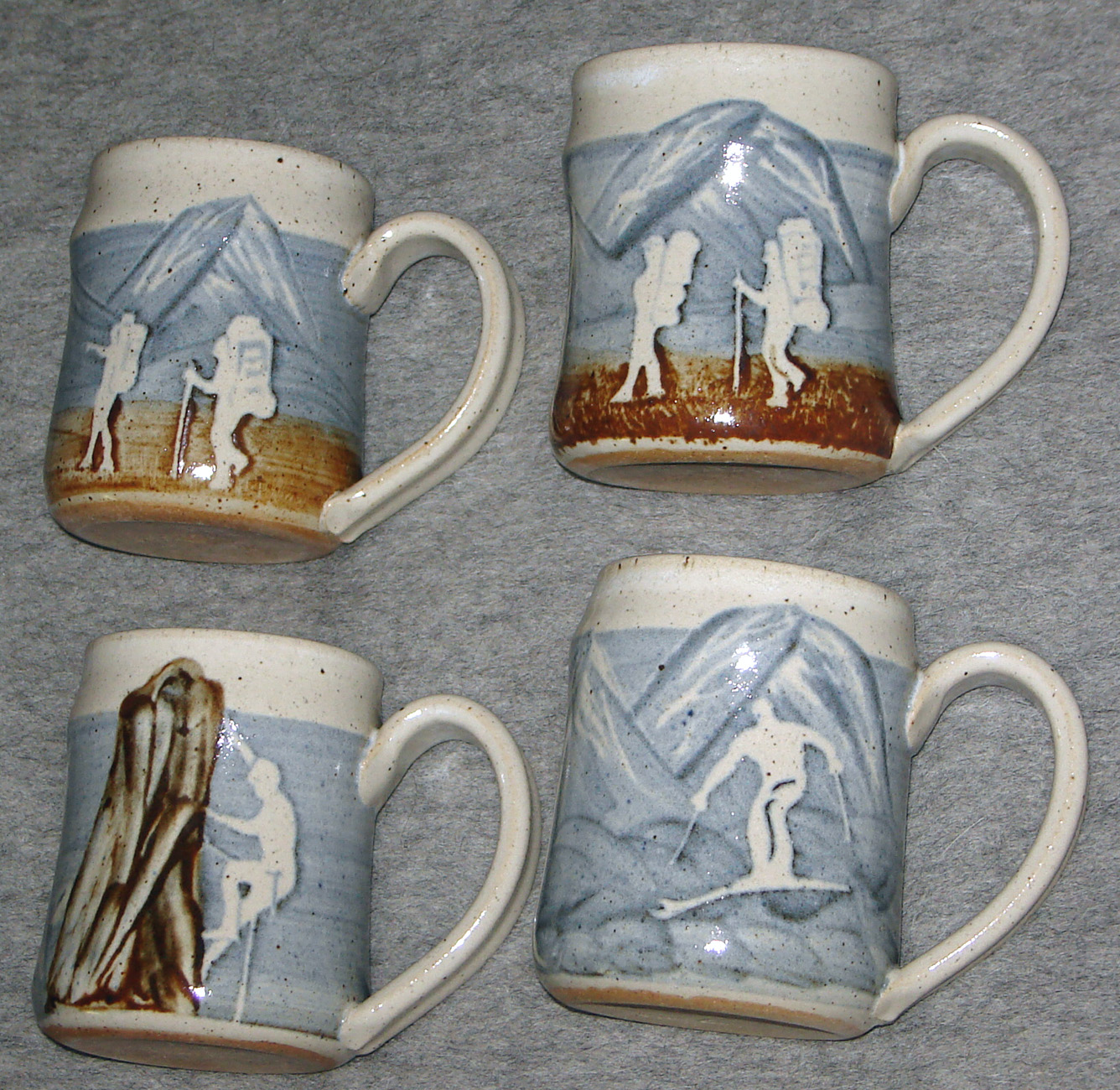
sampling of figured mugs, front view,
showing two versions of hiker, climber, and skier


Each of these mugs are about 4" tall and 3" in diameter, hold a generous 10 ounces, cylindrical with muted blue and brown/tan slipwork under an oatmeal glaze. You can see some pictures on a previous post in February of 2010, and more pictures to come. Mugs are $40 each. Most of the images are also available a large stein (about 16 oz), $50 each.
the back of the mugs usually have mountain scenes
MUGS, THE LIST

Columbine (brushwork)
Aspen leaves - blue
Aspen leaves - brown

Mountains around
Elk
Big Horn Ram
Moose

Eagle
Cranes Dancing
Cranes Flying
Hawks
Hummingbirds
Pheasants

Alpine skier
Nordic skiers
Snowboarders
Telemark skier
Dogsled team

Climber
Hikers
Kayak
Fly fisher
Mountain bike
Road bike

Runners
Golfer man
Golfer woman
Tennis players

Western rider
Dressage riders
Jumping horse
Sail boat
Ballet dancers
Musical notes

I also do a detailed Aspen Forest, which sells for a few dollars more than the other images.

Wednesday, April 4, 2012

Mugs mug shots

These figured mugs are wheel thrown and decorated with colored clay slips, sometimes called engobes.
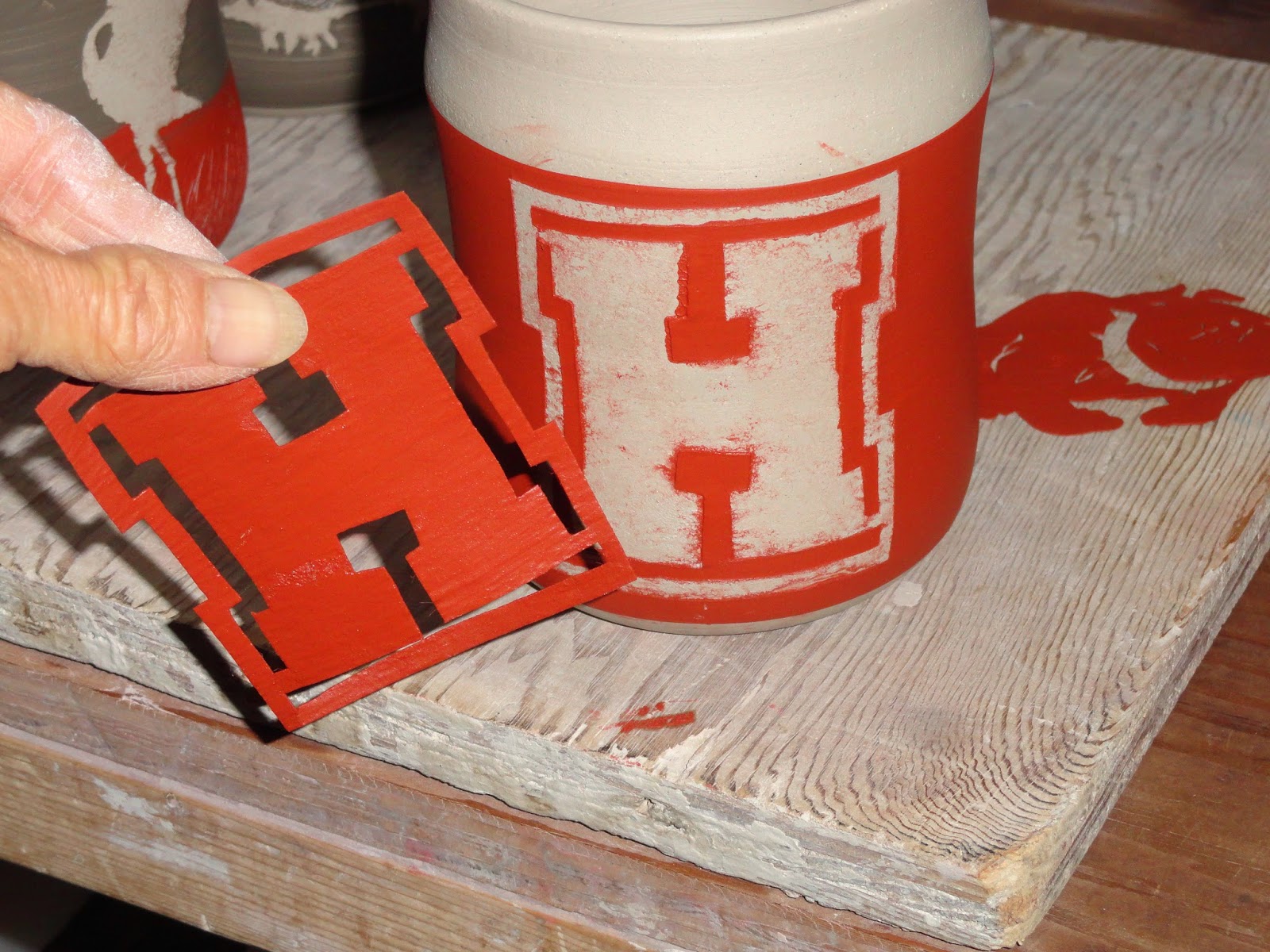
I cut a detailed stencil in order to replicate the images. Usually the back of the mug has a mountain from a stencil and around the figure are free-hand mountain "paintings."
Each mug holds a generous 11 oz. at approximately 4" x 3" x 3" and is made of high fired stoneware: dishwasher and microwave safe.
Dancing Cranes

Flying Cranes

Elk
Moose
Hawk and Eagle
Aspen Forest, extra complex
Brown Aspen Leaves

Bicycle (road bike)

Mountain Bike

Climber

Fisher

Hikers

Kayak
Dressage

Jumping Horse

Western Rider
Alpine Skier

Telemark Skier

Snowboarders "Shredder"
Golfer Man

Golfer Woman
Some available images are not pictured. 
You can see a verbal list at: 


Tuesday, December 9, 2014

Hermiston High Commemorative Mugs

Note: This link: Table of Contents will help you find specific items of our work within this blog.

Hermiston High School Class of '65 will gather for our 50th Class reunion on July 17-18, 2015 
(Hard to believe, but there it is).

In honor of the event, I've agreed to take on the project of making souvenir mugs. They are approximately 4 1/4" tall and 3" in diameter, holding about 11 ounces. Made of stoneware clay, they are dishwasher and microwave safe, lead free. 


Front, showing the Hermiston "H" with
"CLASS   OF '65
HERMISTON
HIGH
50 YRS     2015

Reverse Side shows a Fighting Bulldog
Order information:
Order directly to via postal service or email or phone. Deadline May 15, 2015, but keep ordering; there is still time!
Reserve your mug via email tarasam at tds dot net with "Reunion Mug" in the subject line, or by phone: 970-527-6570.

Free delivery at the reunion in Hermiston. Price each is $20 (a discount from her usual mug price of $24).
Shipping available (if you can't make the reunion) for an additional $8 for the first one and $4 for each additional to the same address. Colorado addresses include 2.9% sales tax. 

Send checks made out to Tara Edna Miller 
41342 O Road
Paonia, CO 81428

Go Bulldogs!

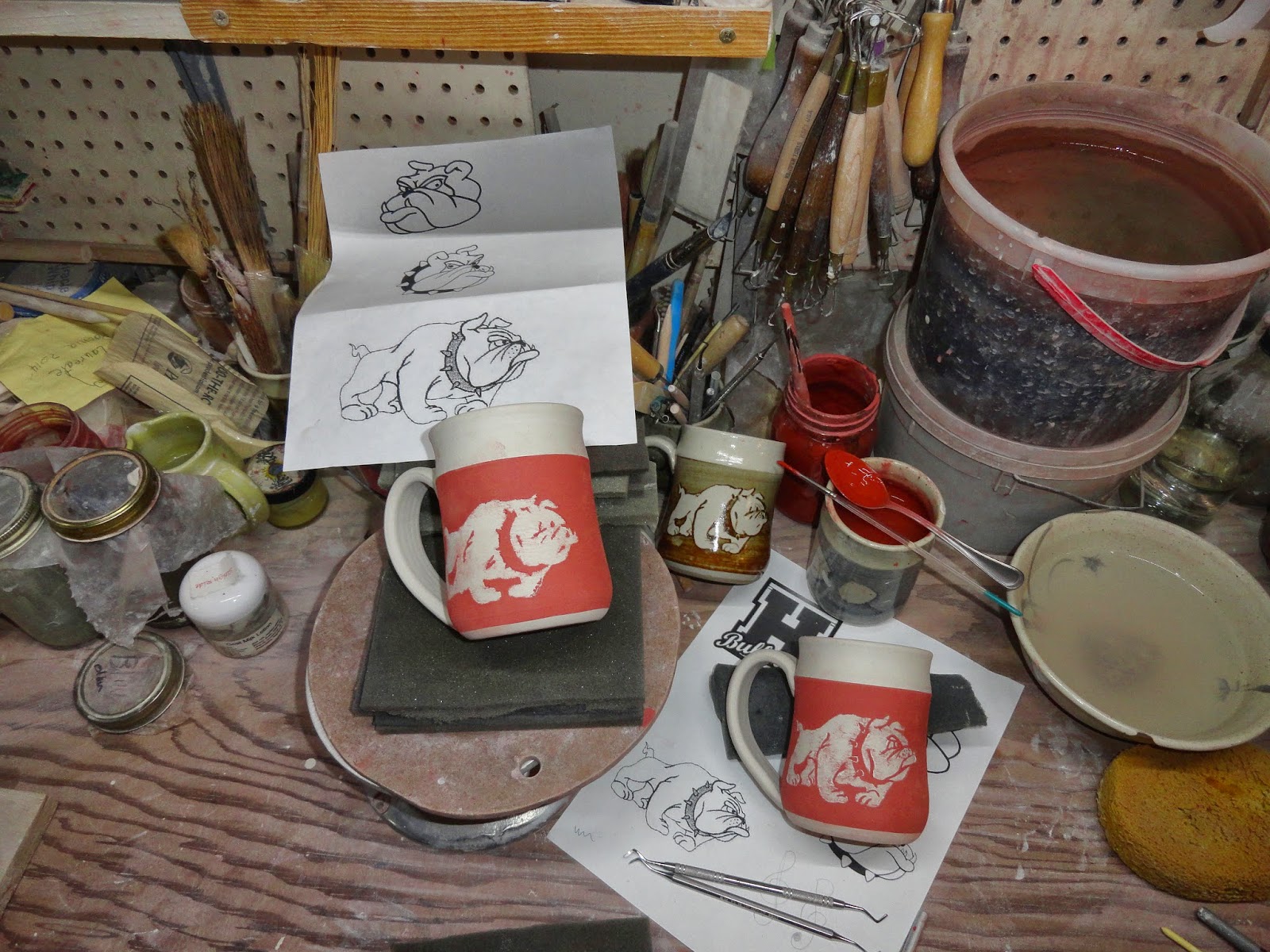
Here are some pictures of the work in progress:

Working with the stencils


Stamp kit to press the letters into the soft clay


detail work to bring out the bulldog

Before and After detail work

Tuesday, November 24, 2020

Side-Saddle Planters

 Retired? Sort of.

I feel deep gratitude for you, our loyal pottery patrons and friends, for all of these years. Thank you for enjoying our production work, the mugs and fruit baskets, bowls and platters.

Note: This link: Table of Contents 
          will help you find specific items of our work on previous posts.

We feel very lucky to be retired this year when the art fairs are all cancelled. We also feel great compassion for those friends who depend on art fairs for their livelihoods, as well as so many in this time of great economic challenges.

Sam has retired completely from the pottery business. He used to claim that he was only a "potter by marriage," with humility toward the amazingly creative work that he made. But he will make no more stoneware fruit baskets. We have some inventory remaining. I continue to create special pieces. However, without a second person to produce, I am very slow to fill our kiln.

Right now I am most interested in planters and bonsai succulents. I've been raising these plants for many years, selling them locally in my handmade planters. It's not a great marketing strategy, but I enjoy working with the living plants and creating unique planters. In particular, I've designed a planter with a built-in saucer. They are usually handbuilt (without the potter's wheel) and highly textured.


I haven't fired all year and have several items all glazed and ready to fire, but I need to fill a bisque firing before proceeding. Here are photos of work in progress:

Most of these mugs will be sold through Sundance Gallery in Buena Vista, Colo.

unglazed planters in process

Overfill in watering will pitcher down into the "saucer."


Firing schedule is undetermined at this point.

TAQUILE ISLAND TEXTILES

In the meantime, we progress with marketing the textiles, fairly traded mostly for solar gear, which we bring home from Peru We have initiated an Etsy site. Do check it out https://www.etsy.com/shop/TaquileFriends

Yes, and for more stories about what this Peru relationship is all about: www.taquilefriends.blogspot.com

Thanks for listening!

Saturday, January 26, 2019

A Solar Project with Heart

By Tamie Meck, Published in the Delta County Independent, Wednesday, November 28, 2018, the Back Page. This article followed a delightful interview with Tamie in our home, and we are grateful for her kind and thoughtful story. I have made a slight factual corrections, in particular about the history of solar in Southern Peru. Much of this article is about our Peruvian project, but it does show a bit of our history as potters as well. We are currently in Peru, Jan-April, 2019, but you can use  
this link:  Table of Contents   to help you find specific items of our work on previous posts.

A solar project with heart

When Paonia potters Sam Brown and Tara Miller married in the mid-1980s, they imagined selling their handmade pottery and living a simple life. She was educated in literature, he had a background in zoology, natural resources and recreation, and they shared a desire to visit the world's great mountain regions. "We live in Colorado," said Sam. "We love mountains."

In 1986 they took their first trip, to Peru and the Andes Mountains. The trip changed the course of their lives, and in turn, changed the lives of others.
Solar panels provides power for homes on Taquile Island, Lake Titicaca, Peru. Paonia potters Sam Brown and Tara Miller first visited more than 30 years ago, and over the years have helped bring solar power to the remote island while helping to market the beautiful textiles.

In the 1970s, Tara enrolled in an evening pottery class while teaching high school English in Coos Bay, Ore. Soon after, she took a year off and focused on her pottery skills. In the early 1980s she moved to Aspen to make picture frames for her photographer sister, and in 1982, began working solely in the pottery studio, studying under some of the biggest names in the field.

Her specialty was heavy ceramic mugs decorated with aspen leaves applied through a resist technique. They sold quite well in the local shops. In 1983, Tara met Sam, a National Parks Service back-country ranger stationed at Rocky Mountain National Park. Shortly after, he took off on a year-long assignment to Alaska, returned to Aspen, and joined Tara in the clay studio.

Sam added Rocky Mountain themes like elk, native birds, aspen trees, fishermen and skiers to Tara's motifs. Themes they continue to use today. "Our pottery sells well as long as we stay within the Rocky Mountain theme," said Sam.

Their trip to Peru took them to Lake Titicaca, located at almost 12,500 feet at the base of the Andes Mountains. A two-hour boat ride from the city of Puno took them to Taquile Island.

A terraced island of just over two square miles, Taquile's economy is based on agriculture and tourism. It has largely avoided outside influences for centuries. As a result, said Sam, there are no cars, bicycles, dogs or guns on the island. As they have been for centuries, major decisions are made collectively. Recently the residents thwarted efforts to commercialize and build hotels.

"It's a real peaceful society," said Sam. "You walk everywhere."

Taquile is known worldwide for its fine textiles, made using centuries-old knitting and weaving techniques, and from which their colorful and traditional clothing is made. In 2005, Taquile's textile arts were proclaimed "Masterpieces of the Oral and Intangible Heritage of Humanity" by UNESCO.

Most tourists stay a couple of hours, take photos and buy textiles before heading back to Puno. Sam and Tara planned to stay two nights and were assigned a host family.

One modern technology only beginning to be introduced in the region was solar power, but it was unknown on Taquile Island. What little power they had came from lead-acid batteries. Charging them meant a three-day round trip to Puno. Tara and Sam knew about solar power both through association with the Rocky Mountain Institute and through a new renewable energy program at Colorado Mountain College in Aspen, which in 1991 would morph into Solar Energy International. The environmental risks of the lead-acid batteries were a big concern, they said.

Their host couple were weavers. They showed Sam and Tara their beautiful textiles and shared their dream of going to America to sell their goods and teach their craft.

"Being craftspeople ourselves, we bought into the dream," said Tara. Their two-night stay turned into a week. In 1988, they returned, smuggling in a 9-watt solar panel. They wired the panel to a radio and played music. To the residents, "It was like magic," said Sam.

Everyone wanted a panel, they said. They traded the panel for textiles, which they sold back home at local craft fairs, and re-invested the money in more solar panels to take with them on their next trip.

Taquile's inhabitants gained more than solar power, they gained a family. On Taquile, says Tara, "We're 'Madrina and Padrino,'" Godmother and Godfather.

Tara and Sam moved to Paonia in the early 1990s and set up their clay studio. It hasn't made them rich, but that was never the plan, they said. Tara began ceramic mugs, platters, bowls, planters, and other objects, and Sam made clay coil stoneware fruit/bread baskets. They were busy with family life, and in winters sold Christmas trees in California for Sam's family's business.

In the mid-1990s they returned to their Taquile family, and have returned almost every year, always packing solar equipment for trade. Back home, they sold textiles alongside their pottery. "We figure that was their currency because it's good stuff," said Sam. Since they only need to make enough to buy more solar equipment, the markup is small. Items sell well, and people who know weaving recognize the fine detail of the weaving and understand the skills required to make it.

Through the years Sam and Tara have also brought Taquile residents to America. One year the Smithsonian Institution hosted a group of Taquile residents. The Smithsonian paid their expenses, but when offered money, "They wanted solar panels," said Sam. "The Smithsonian had to run around and buy solar panels to pay them."

SEI moved from Carbondale to Paonia in 2002. When they offered a class on solar energy in the developing world, Tara and Sam gave a lecture on Taquile. Most lectures were filled with technical speak, they said. They spoke about smuggling solar panels into Peru, trading panels for textiles, and how much they loved the people. "We were the project with heart," said Tara.
Sam shares a happy moment with three young sisters on Taquile Island, Lake Titicaca, Peru, where he and wife Tara are known as ‘Madrina and Padrino,’ Godmother and Godfather.

Tara and Sam are still living simply and making pottery in the home studio. At the height of their career, they did as many as 12 craft shows a year. They could have had more lucrative careers, but instead made a conscious choice to maintain control of their lives. They wanted the flexibility that allows them to hike or travel and work in their studio. "We knew we were choosing the lower money route, but we were choosing a quality of life, other than a 9-to-5 job," said Sam.

After more than 30 years, they're cutting back on craft fairs and slowing production. They plan to create more local venues and set up shop online. The demand is still there, said Tara. She recently enlisted the help of an assistant to work in the studio.

They also plan to continue visiting their Taquile family. They recently established a program to provide school supplies to the local children. Two years ago, Brad Burritt and Danielle Carre with Empowered Energy Systems in Hotchkiss traveled to Taquile to install two small solar systems. Through a YouCaring campaign, they raised money and returned last year with son Asa, a solar installer who speaks Spanish, to teach a solar installation class. Four Taquile residents earned their diplomas and now have textbooks to refer to.
Paonia Artists Sam Brown and Tara Miller wear traditional clothing for the annual Carnival celebration on Taquile Island, Lake Titicaca, Peru. In 2005, UNESCO proclaimed Taquile Island’s centuries-old tradition of textile weaving and knitting as “Masterpieces of the Oral and Intangible Heritage of Humanity.”

Their positive influence on the island continues. Recently their godson was re-elected to town council. When a diesel fired water-pumping project was proposed, which would belch diesel smoke and not bode well with the tourists, he lobbied for solar, and won. Thanks to the resulting project, the island now has three water pumping systems, virtually eliminating the need to haul water.

Hauling water, said Sam, is considered one of the biggest jobs in the developing world. On one trip to Taquile they had to haul water, and almost cried when they got home and turned on the faucet. "It's so amazing that we have running water, both temperatures, and it's clean," said Tara.

On their most recent trip, they brought home dozens of textiles -- hats, gloves, scarves, belts and purses. Some pieces are tagged with the artist's name, type of wool used, and a short story. As they have for many years, this Friday and Saturday they will have a booth at the annual Holiday Art Fair at the Blue Sage Center for the Arts in Paonia.

Their years of work and visits to Taquile Island are documented in words and photographs at www.taquilefriends.blogspot.com.

Thursday, July 12, 2012

Wowza! Sculpture show at the Hotchkiss Creamery

"Wowza! your pieces at the creamery are fantastic.  they are so original.  i love the little faces in the flowers,  the glazes are really well done."-comment from artist Erin Williams
Iris Reverie
It's almost a retrospective, the first time many of these sculptures have been seen all in one place. I'm really proud of this collection of my Ceramic Sculptures and hope to see lots of friends and patrons at the opening for refreshments (I'm bringing an awesome pesto dip) and maybe even a poetry performance (The Potter's Claim with the white gloves).
Opening in the Peach Gallery at the Creamery in Hotchkiss 
on Friday July 13 6:00-8:30pm.
Show continues through August 6.
If you know my work as only strong functional stoneware pottery: mugs and serving ware, you're in for a treat with this show of expressive botanical themes executed in Stoneware and Porcelain. Most items are for sale.


Thursday, July 1, 2010

Art and Craft Fair Schedule, 2010

Our final shows for 2010 will be Thanksgiving weekend in Arvada, Colorado at the beautiful Arvada Center, followed by the Paonia Holiday Craft Fair at the Blue Sage Center in Paonia.

We look forward to seeing you at the fair!

You can see images and descriptions of our pottery in earlier posting of this web log.

Exciting news accompanies this announcement:
Our Peruvian Family will be joining us!

You may be aware that we have been visiting Taquile Island, Lake Titicaca, Peru since 1986 and have a deep and close relationship with extended family and friends in that indigenous community. The excitement is that a Taquile dance troupe is being brought to Albuquerque (at the U of NM Nov 16-19) and we are then bringing three of these textile artists to the two shows where you can see our work:

The Arvada Center Holiday Art Show Thanksgiving weekend:
9-5 on Friday Nov. 26 and Saturday Nov. 27. 6901 Wadsworth Boulevard in Arvada.
Our booth is #132 on the main level in the center of the room to the left of the stairs and the Peruvian Natives booth just across from ours in #119


The Paonia Holiday Craft Fair at the Blue Sage in Paonia: 3-8 on Friday, Dec. 3 and 9-5 on Saturday Dec. 4, where we will take over the whole stage with pottery and textiles plus weaving and knitting demonstrations.

Both shows will have our pottery booth with our unique Stoneware Fruit/Bread Baskets, Bowls, Figured mugs, and all the functional and sculptural work we've been making for you this year--AND a textile display from Taquile, a designated A UNESCO Cultural Heritage Site for its Textile Art, with open fingered gloves, wool hats, woven belts, ponchos, shawls and bags.

In addition, we will make two public presentations with our Peruvian guests:
in Aspen at ACES on November 29, 6:00pm, and
in Paonia at the Blue Sage on December 6 at 6:30pm.
See more information about "A View from the Andes" at www.taquilefriends.blogspot.com

See you at the fairs!

If you can't make it to the fairs, feel free to give us a call to place an order. 970-527-6570

Or, you may find what you're looking for at our Colorado galleries:
The Earthen Vessel in Durango
Handworks in Crested Butte
Working Artist's Gallery in Grand Junction
Max'ims of Greeley and Estes Park
Munson's Main Street Gallery in Cedaredge
and Toklat Gallery in Basalt.

Thursday, July 6, 2017

Elk, Aspen Forest, Mountains and Hawk

Elk are the predominate wildlife theme in
Rocky Mountain National Park
Elk "Chip & Dip" Bowl: 12.25" diameter and 2.75" high
We will be showing at the Grand Lake Arts and Crafts Festival, on the western edge of the Park, presents July 9-10, 2017
SHOW HOURS: Saturday, 10:00 AM-5:00 PM and Sunday, 10:00 AM-4:00 PM We will be bringing a fine selection of Elk-themed pieces: platters and serving pieces as well as pie plates and mugs and steins; also elegant fruit baskets made of strong, washable stoneware clay. Note: This link:  Table of Contents    will help you find specific items of our work on previous posts.
Here I show you the slip-painting process of the large, wall-hanging serving piece that I call a "Chip & Dip," one brushstroke at a time.
first, the blank stencils

next, shadows under the branches

then all those wonderful knots and scratches on the aspen bark

and finally, the trunk wrinkles, horizontal but with a slight curve
The following is the side view, showing the open curved foot. See the face of the final fired piece at the top of this page.

Friday, February 8, 2013

Table of Contents

Because this is a Blog and not a regular website, The following Links will help you maneuver around the site and find pictures and descriptions of various types of pottery. Be sure to scroll down the page to see the various posts.

BOWLS Link


MUGS Links


SCULPTURE Link


SERVING PIECES Link

BASKETS Link

GALLERIES:

We often travel to a community in Peru which we have been visiting for nearly 30 years. You can follow our travel blog at www.taquilefriends.blogspot.com

To find our work in the meantime, our pottery is sold at the following COLORADO GALLERIES:

Sundance and Friends 1111 River Park Road --Buena Vista -- (719) 966-5361
http://www.sundanceleather.com/Retail-Store_ep_46.html

Pfister's Handworks -- 302 Elk Avenue -- Crested Butte -(970) 349-6731
https://www.facebook.com/Pfisters-Handworks-1072934496065933/

Working Artists' Gallery -- 520 Main Street -- Grand Junction -(970) 256-9952
https://www.facebook.com/workingartistsgallery/?rf=134534513264915

Earthen Vessel Gallery-- 115 W 9th St -- Durango -(970) 247-1281

Limited selections can also be found in Paonia, Colorado, at
The Blue Sage Center for the Arts 226-228 Grand Ave --Paonia --(970) 527-7243
The Old River Road Trading Post -- 15495 Black Bridge Road -- 970-527-4740

ARTIST BIOGRAPHY Read about who we are.

Sunday, May 29, 2022

Retrospective biography

 I wrote a two page summary of my pottery life to tape to the wall at the art show at the Blue Sage Center for the Arts. Here it is:

Tara Miller ~ Artist Biography

Note: This link: Table of Contents 
          will help you find specific items of our work on previous posts.

Introduction to Clay

My first memory of working with clay was about 3rd grade in Hermiston, Oregon, a clay duck for Mother's Day. I took my first real pottery class in 1972 at Southwestern Oregon Community College in Coos Bay, Oregon, while teaching high school English, just to “play in the mud,” and the clay captured my imagination. That teacher advised beginners to keep a piece of our earliest work, to “keep yourself humble.” (I have that piece, but it is not in this show.) After a couple years of teaching, having saved enough money to “take a year off,” I found places to do pottery. I even fired in a burning barrel with the pots buried in smoldering sawdust. I only returned to teaching English much later with a few offerings in the Paonia Vision homeschool program.

Portland, Oregon 1974-1976

Eventually I landed a job as lab assistant at Portland Community College. There I managed glaze inventory and studio organization, and fired the kilns. This gave me not only a place to work and studio management experience, but access to workshops and lectures with master potters such as Betty Woodman, Tom Coleman, and P. K. Hoffman. Woodman's stretched platters directly inspired my work that resulted in the Triptych Vessels and hanging oval platters that you see in this show. 

Pyromaniac Potters

I attended a couple of crazy two-week summer workshops near Hood River, Oregon, hosted by P. K. Hoffman. We built the kickwheels, made pottery, gathered firewood, and stacked the raw pots on kiln shelves. Then we actually built the kiln AROUND the stacked pots, and fired for three days with wood and salt to a very high temperature. All the while we camped in the cherry orchard and bathed by secular sweat lodge (“Hot Rocks!”) with a cold plunge in the creek. 

Mentor, Paul Soldner

P. K's primary mentor was Paul Soldner, so when I was getting ready to build my own kiln and learned of a kiln-building workshop with this master, I jumped at the chance and spent two weeks in Seattle at the base of the Space Needle at the new location for Pottery Northwest. We built 8 kilns in 2 weeks. Soldner became my primary mentor, with his flamboyance and willingness to experiment. Over the years our friendship and his influence continued after I moved to the Aspen area. When asked the difference between art and craft, Paul would reply, “It's art if you are continually making decisions; craft when you already know what you are doing.”

Wood firing, unrealistic marketing

After that workshop, I built my own kiln at a rented home outside Portland, Oregon, dug my own clay and fired with free firewood. My main products were red-clay flower pots with beautiful ash effects, but dime-store planters were my competition. In retrospect, I should have taken the inspiration from Soldner and made more flamboyant sculpture.

Guatemala, 1975

So I went travelling and ended up living with a family of indigenous potters near Totonicapan, Guatemala. They actually prepared their clay, dug from a pit in the back yard, on a metate con mano. It was the only task I couldn't help with, as I got blisters within a brief stint at the grinder. Miguel asked me to marry him, saying that working together without being family was “child's play,” but I declined. Anyway he was already married. I made small flutes myself and sold a few in the market at absurdly low prices. Mainly I learned the techniques of Miguel's family's practical and beautiful tamale steamers. We fired with wood, my Spanish language skills improved greatly, and the memories of that experience greatly enrich my life. 

Aspen and Snowmass 1976-1990

Shortly after returning to the states I moved to Aspen and worked as a picture framer for my sister's photography business, Hill Photography. I learned a lot about art and art marketing as well as photography and framing. During that time, I took classes at Colorado Mountain College, Aspen campus, and eventually quit my framing job and worked again as studio manager. Finally in 1982, I turned my pottery hobby into a full-time profession.

Anderson Ranch

All the time I was in Aspen, I participated with the Anderson Ranch Art Center. One winter, I rented studio space in their drafty barn. In the summer during their teaching season, I was privileged to attend potlucks and Tuesday night free lectures in all media, which fed my soul and knowledge of art and ceramics. I took workshops from such notable masters as John Glick, Victor Babu, Chris Gustin and Jenny Lind. I also participated in several clay symposia, including California Clay in the Rockies, with memorable lectures and demonstrations from such giants in the field as Daniel Rhodes, Peter Voulkos, Ruth Duckworth, Don Reitz, Toshiko Takaezu, Patti Warashina, Michael Frimkess, Bob Sperry and, of course, Paul Soldner. I also learned much from fellow students and managers at The Ranch, most notably, Doug Casebeer and David Strong.

Marriage and Partnership 

In 1984 I married Sam Brown and our partnership allowed us to make more clay work and to travel and sell together at art fairs. The full time commitment made us a living and allowed the freedom to travel. In particular, we have made a relationship with an indigenous community on Taquile Island, Lake Titicaca, Peru, which we have visited regularly since 1986. We introduced solar energy and continue to help with this technology. The people there are textile artists, and we find a commonality in shared craftsmanship, even if in different media. Though I have played with clay found on the island and taught with children, I have never been able to fire successfully there. Fuel is too scarce. 

Paonia

We moved to Paonia in 1990 and continued production, selling in both galleries and juried art fairs. I created a line of slip-decorated mugs with wildlife and sports themed images; Sam focussed on handbuilding, in particular open-structured fruit baskets. My studio has at least 15 glazes that can be combined for many colors. I've made full dinnerware sets and all manner of functional stoneware. In 2005, I organized the art show in conjunction with the first production of the Vagina Monologues in Paonia, and created several pieces for that show, celebrating the woman's body. I once had a one-woman show called Poem Pottery wherein the pottery was inspired by my poetry, some with poems written on the pots. 

Retirement?

We retired from full-time production pottery in 2019 (just in time for the pandemic) and Sam no longer works with the clay. I continue to express myself in clay and my most current interest is in planters and plants. My mentor, Paul Soldner, was also a bonsai artist, and I have taken inspiration from his work to propogate plants and find ways to harmonize the living plants in their ceramic homes. 

Thank you for attending this show, which includes so many pieces from this history.

Tara Miller